Papyrus Lint catches bugs that CreationKit's compiler lets through
PapyrusCompiler.exe only checks that a script is syntactically valid — it will happily compile
a script that dereferences a None object at runtime, passes a String where an
Int is expected, returns the wrong type from a function, compares an Int to a
Float inexactly, or contains a branch that can never execute. Papyrus Lint scans your
.psc source for exactly these patterns before you ship, on top of the formatting/style issues
a linter usually catches — as a desktop app, a CLI, and editor extensions.
A simple example
This compiles cleanly, but silently passes the wrong argument:
Function DoSomething(Actor a, Actor b, Form SomeItem)
a.RemoveItem(SomeItem, 1, b);
EndFunction
Function DoSomething(Actor a, Actor b, Form SomeItem)
a.RemoveItem(SomeItem, 1, false, b);
EndFunction
The Strict boolean check lint catches this: the first call passes the Actor
value b to a Bool parameter.
What is a linter?
A linter is a tool that scans source code for patterns that are likely to be mistakes, bad practice, or
inconsistent style, without actually running the code. It works from heuristics — recognizable patterns
known to often cause problems — rather than proving that a given line is definitely wrong. Because of that,
a linter can produce false positives. Treat every diagnostic as
advice, not a guaranteed defect report: use your own judgment, and use an
; @disable comment to silence a rule you've decided doesn't apply.
What this is NOT
A compiler (it uses the standard Papyrus compiler under the hood), an editor, a guarantee a script is fit for purpose, or a replacement for proper testing.
What this IS
A desktop app, standalone CLI, and editor extensions that all share one lint/repair engine, so a diagnostic looks and behaves the same everywhere you run it.
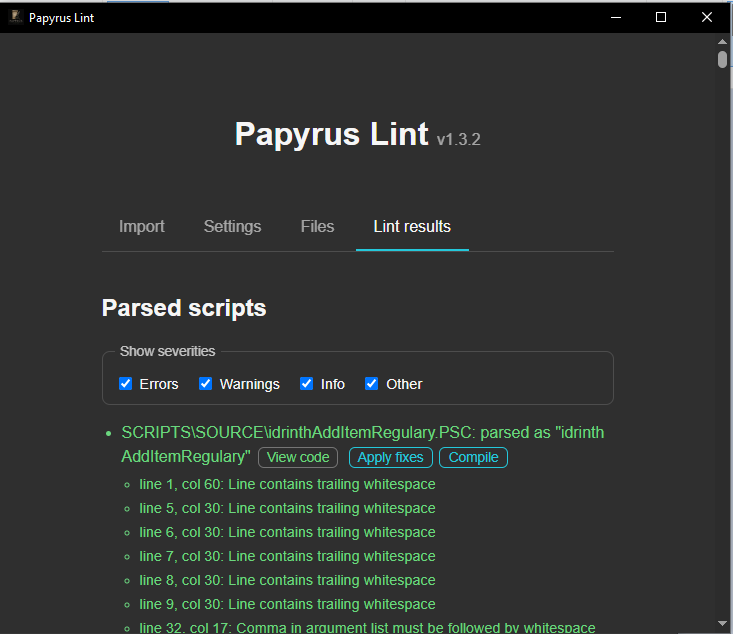
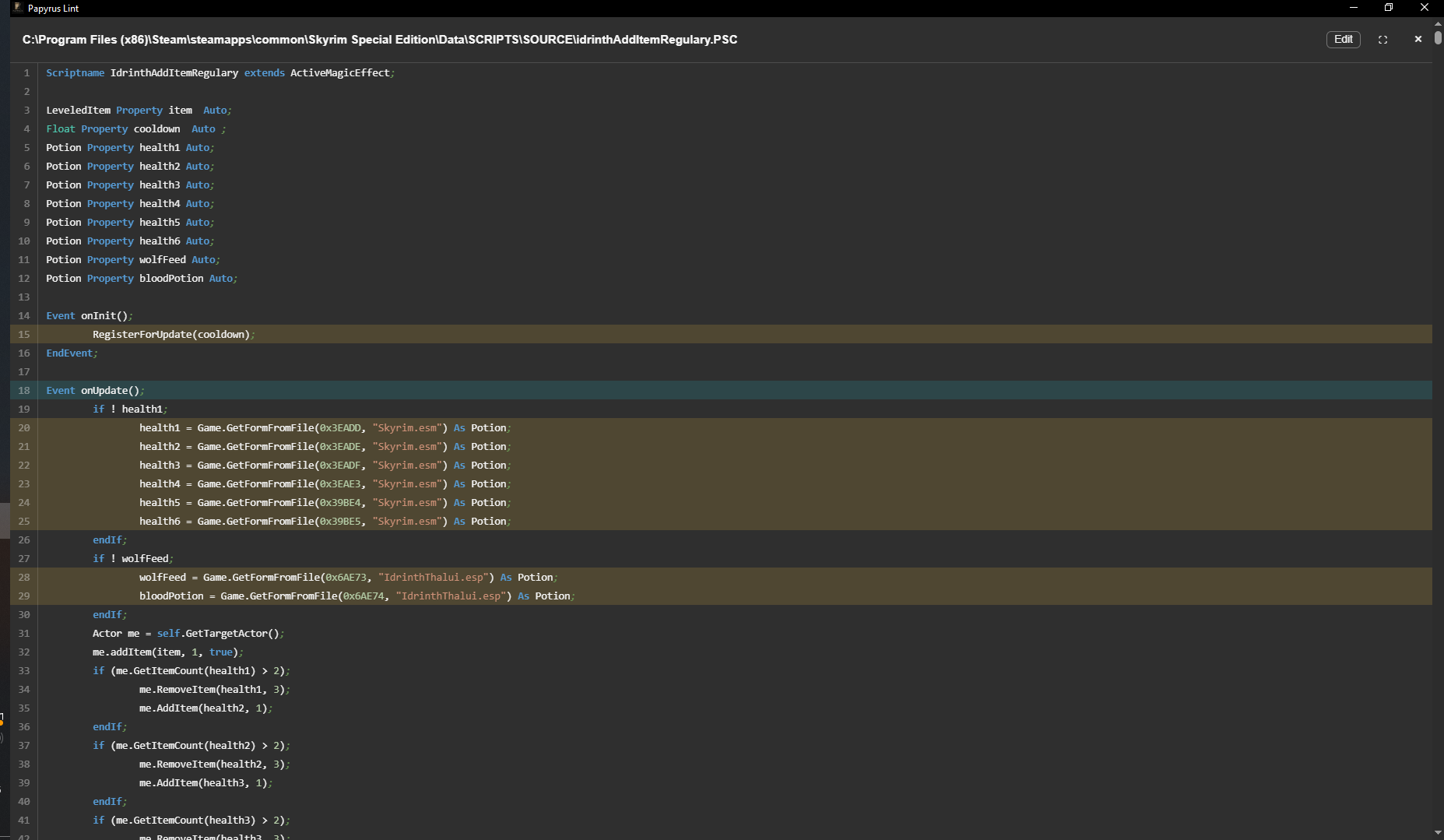
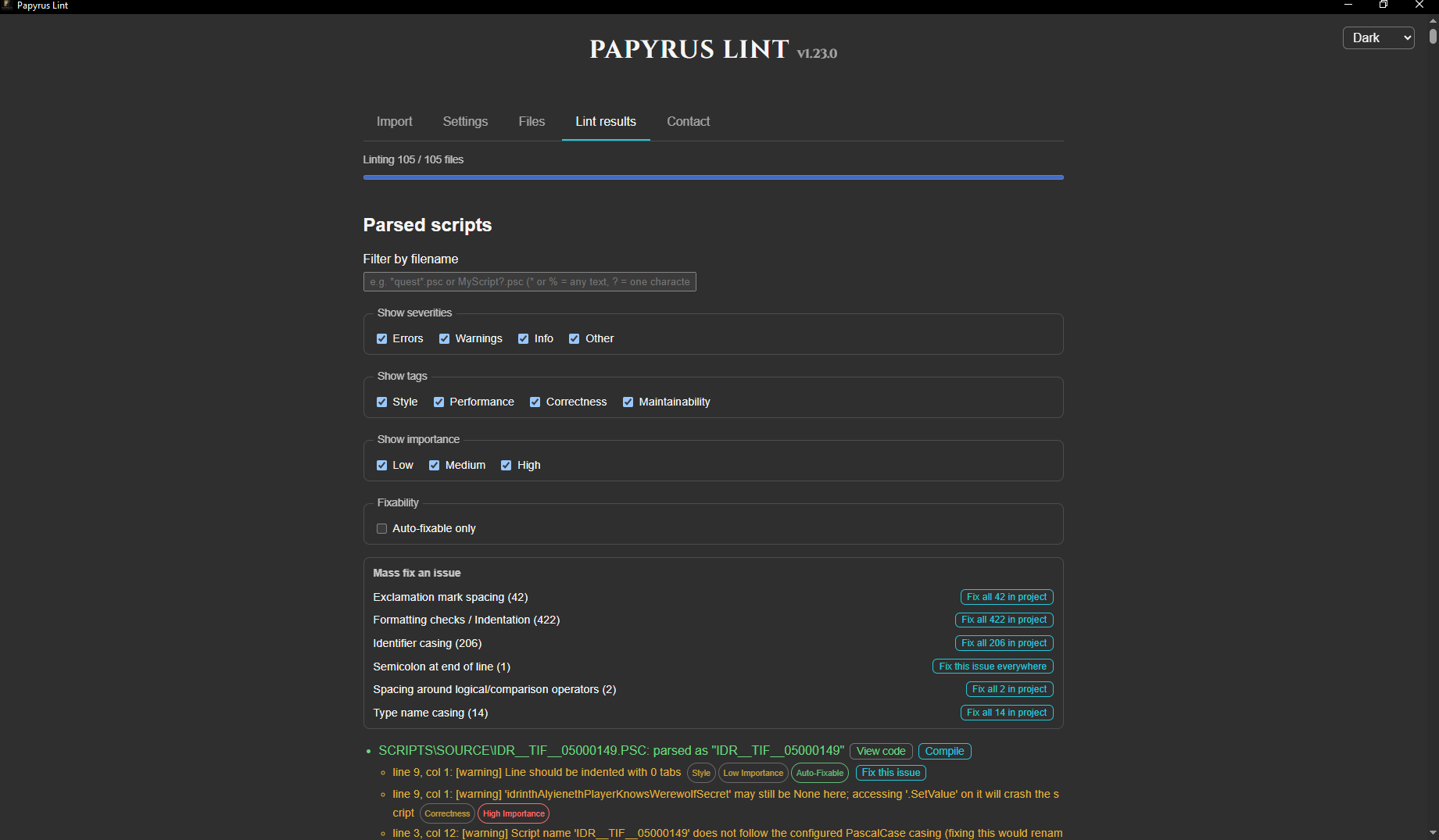
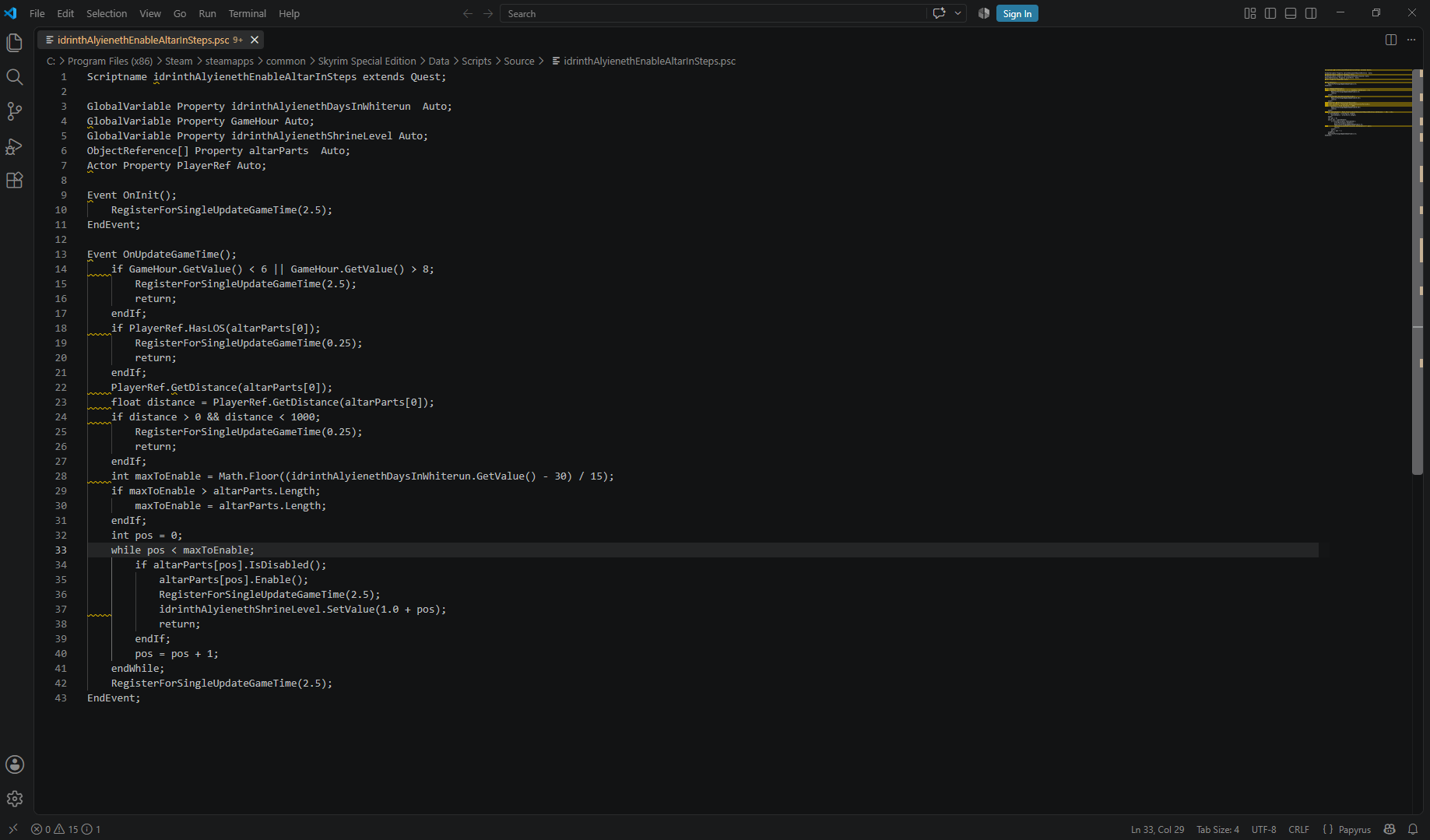
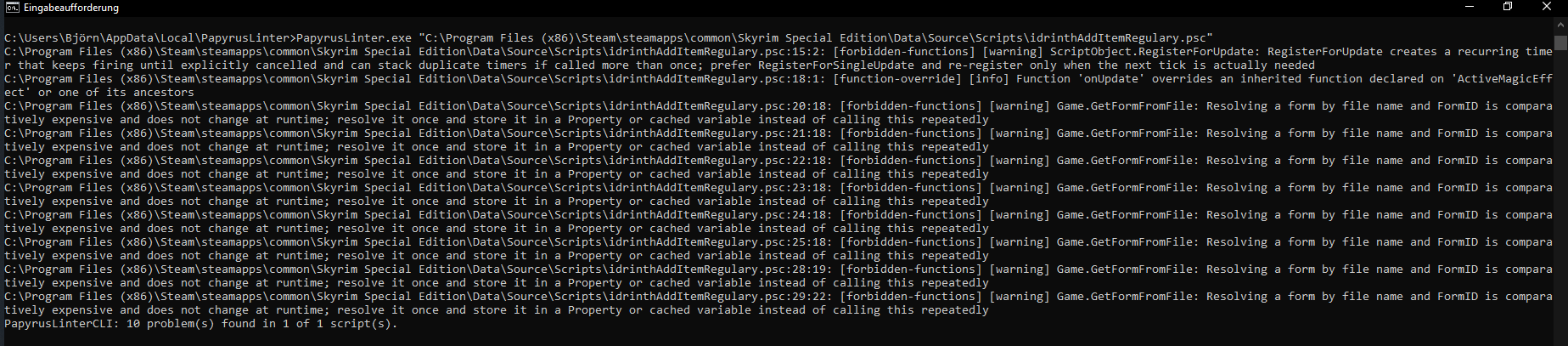
See it in action
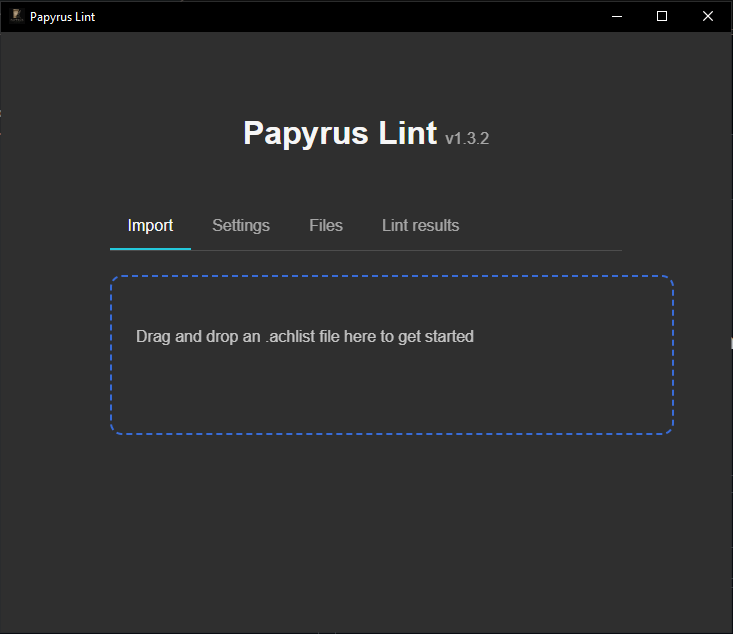
Drop a .achlist or a single .psc file to get started.


Implemented lints
Every rule works from raw source or lexer tokens rather than requiring a script that parses cleanly. The tables below are generated directly from the README at deploy time, so they always match its documented behavior.
Formatting
| Lint | Description | Auto-Fix |
|---|---|---|
| Trailing whitespace | Flags, as a [warning], lines that end with trailing spaces or tabs. | ✓ |
| Space after comma | Requires, as a [warning], whitespace after commas in argument lists. | ✓ |
| Semicolon at end of line | Requires, as a [warning], a trailing semicolon on each non-empty line or forbids terminal semicolons, according to the selected setting. | ✓ |
| Formatting checks | Flags, as a [warning], lines whose indentation doesn't match the configured style/width (indentation/indentation_width) for their nesting depth. A script whose structure can't be identified (e.g. it doesn't lex cleanly) is left unchecked rather than guessed at. | ✓ |
| Whitespace interrupting property/method chaining | Flags, as an [error], a space or tab immediately before or after a . member/method access (e.g. SomeProperty . DoThing()), since it interrupts the chain for no benefit. A . inside a Float literal (e.g. 1.5) is never flagged. The fix closes the gap on whichever side(s) have it, without reaching across a newline (a chain continued onto another physical line is left alone). | ✓ |
| Exclamation mark spacing | Flags, as a [warning], a ! negation operator not followed by exactly one space (e.g. !bReady or ! bReady), since a bit of breathing room makes the negation easier to spot. Never flags !=, which the lexer tokenizes separately. The fix inserts a space where there is none and collapses a longer run of spaces/tabs down to one. | ✓ |
| Type name casing | Flags, as a [warning], a script's declared type name (the identifier following ScriptName) if it doesn't follow the configured type_casing convention (PascalCase, camelCase, lowercase, or UPPERCASE). Only the script's own declared name is checked and fixed, never its Extends target, since that type is declared (and presumably already checked) in another script. The fix only changes letter casing, preserving the name's characters so it remains compatible with its .psc filename; a violation that would require a substantive rename (such as removing an underscore for PascalCase) is left for the user to rename together with the file. | ✓ |
| Identifier casing | Flags a declared function/event, property, state, parameter, or local/script variable whose name doesn't match the configured identifier_casing style: camelCase, PascalCase, snake_case, or CONSTANT_CASE. ScriptName itself is never checked by this lint (see "Type name casing" below). A parameter has no location of its own, so it's reported on its enclosing function's line. The automatic fix renames each flagged declaration and its references only when the conversion preserves every underscore in its original position; fixes that would add, remove, or move underscores are left for the user because they constitute a substantive rename. | ✓ |
| Spacing around logical/comparison operators | Requires, as a [warning], exactly one space on either side of &&, ||, ==, !=, >, <, >=, and <=. A side whose whitespace reaches a newline (the operator opens or closes a statement continued across physical lines) is left unchecked on that side. The fix normalizes each flagged side to a single space, without reaching across a newline. | ✓ |
| Property sorting | Flags, as a [warning], a Property declaration that isn't sorted by type and then alphabetically by name, or that isn't declared immediately after the ScriptName line, before any variable, function, or state declaration (an Import isn't tracked closely enough to count against this). Disabled by default, since reordering a script's declared properties is a more invasive change than the rest of these lints; a project opts in via rules.property_sorting. The fix relocates each property's own declaration lines (its full Property/EndProperty block, for a non-auto property) as a group right after ScriptName, in sorted order; a documentation comment placed directly above a property is left behind rather than moved with it. | ✓ |
Performance
| Lint | Description | Auto-Fix |
|---|---|---|
| Forbidden/discouraged function usage | Flags calls to functions listed in rules/forbidden-functions.yaml (e.g. slow or blocking native calls), with a configurable severity and an explanatory message per entry. | |
| Slow function usage | Flags calls to functions listed in rules/slow-functions.yaml that have a faster equivalent available, and suggests the quicker alternative. The fix replaces the complete call with that rule's supplied replacement, preserving the original argument where the replacement uses the value placeholder. | ✓ |
| Short wait/update interval | Flags, as a [warning], a call to Utility.Wait, RegisterForUpdate, RegisterForSingleUpdate, RegisterForUpdateGameTime, or RegisterForSingleUpdateGameTime whose interval argument folds to a compile-time-constant number below the configurable min_wait_interval (default 0.1), since an interval that short runs far more often than is typically useful and can add up to meaningful performance overhead. Utility.Wait is only matched when qualified by that literal script name, the same way the "Forbidden/discouraged function usage" lint treats native singletons; the RegisterFor* family matches unqualified or through any receiver. Only an argument built entirely from literals (combined with arithmetic and unary operators) is checked; one that depends on an identifier, a call, Self/Parent, a member/index access, a cast, or a new array is left unflagged rather than guessed at. | |
| Repeated GlobalVariable.GetValue() calls | Flags, as an [info], a GetValue() call repeated on the same receiver across the conditions of a single If/ElseIf chain (e.g. If gv.GetValue() == 1.0 / ElseIf gv.GetValue() == 2.0), since none of the chain's earlier branch bodies run before a later condition is evaluated, so the value can't have changed between those reads — it can be read into a local variable once ahead of the chain instead. Like "Slow function usage", a call's receiver can't generally be resolved back to a GlobalVariable-typed script, so this matches by the GetValue method name alone (case-insensitively, with no arguments); it's the only native method with that name (see rules/native-methods.yaml), so this doesn't misfire on unrelated types. Disabled by default, since a chain that reads the same global more than once is often written that way deliberately for readability and the performance cost is usually negligible outside a hot code path; a project opts in via rules.repeated_getvalue. |
Reliability
| Lint | Description | Auto-Fix |
|---|---|---|
| Getter usage without saving result | Flags calls to functions whose names begin with Get (case-insensitively) whose result is discarded, whether the call stands alone (GetValue()) or only feeds a comparison, arithmetic, or logical operator whose own result is then discarded too (e.g. GetDistance(target) > 0 on its own line, with no assignment, Return, or condition around it). | |
| Strict boolean check | Flags If/ElseIf/While conditions that aren't already a Bool value or expression, instead of relying on Papyrus's implicit conversion to boolean. Only conditions whose type can be determined locally (locals, parameters, properties, literals, casts, and comparison/logical expressions) are checked; a condition that depends on a function call or a member access is left unflagged rather than risk a false positive. By default (bool_like_int: true), the Int literal 1 or 0 used directly as a condition is allowed as a common "bool-like" idiom; any other Int value (including a variable or property that happens to hold 0/1) is still flagged, and setting bool_like_int: false flags the literals too. | |
| Argument type check | Flags call-site arguments whose type doesn't match the callee's declared parameter type (e.g. passing a String where an Int is expected), allowing the implicit Int-to-Float widening Papyrus itself allows, as well as passing an object whose script extends (directly or transitively) the parameter's type (e.g. passing an Armor where a Form is expected, or an Actor where an ObjectReference is expected). Calls to functions declared in the same script are always checked; when linting a .psc file dropped in the app, calls to functions declared on other scripts under the project root (e.g. SomeProperty.DoThing(...)) are checked too, by resolving those scripts' signatures (including through Extends), and the Extends chain of an argument's own script is likewise resolved from the project root to allow compatible subtypes. Native engine types (e.g. Actor, ObjectReference, Form, Spell) whose own .psc isn't part of the project fall back to the common Skyrim/Fallout 4 native class hierarchy listed in rules/native-types.yaml, so a subtype relationship between them is still recognized. A call whose target or argument type can't be determined is skipped rather than guessed at. | |
| Return type check | Flags Return statements whose value's type doesn't match the enclosing function's declared return type (e.g. returning a String from a Function declared Int), allowing the implicit Int-to-Float widening Papyrus itself allows, as well as returning an object whose script extends (directly or transitively) the declared return type (e.g. returning an Armor from a Function declared Form, or an Actor from a Function declared ObjectReference). When linting a .psc file dropped in the app, a returned value's own script's Extends chain is resolved from the project root to allow compatible subtypes there too, with the same native-type fallback used by the argument type check for engine types like Actor/ObjectReference/Form. A Return whose value's type can't be determined, or with no declared return type, is skipped rather than guessed at. | |
| Inherited function override | Flags, as an [info], a function declared on this script that shares its name with a function declared on the script it Extends (directly or transitively) — the local declaration silently replaces the inherited one. This is often intentional (e.g. overriding an Event OnInit() handler), so it's informational rather than a warning. Only checked when linting a .psc file dropped in the app, by resolving the Extends chain from the project root; a function declared inside a State block is not checked (state-based override is a separate mechanism from Extends). | |
| Argument naming consistency | Flags, as a [warning], a function declared on this script whose parameter name doesn't match (case-insensitively) the corresponding parameter of the same-named function declared on the script it Extends (directly or transitively) — since Papyrus resolves a named-argument call against the declared type of the reference it's called through, a renamed parameter on an override can silently misdirect (or fail to compile) a caller using the parent's names. Only checked when linting a .psc file dropped in the app, by resolving the Extends chain from the project root; a function declared inside a State block is not checked, and only parameter positions present on both declarations are compared. | |
| State function signature mismatch | Flags, as an [error], a function or event declared inside a State block whose parameter count/types or return type doesn't match the same-named declaration in the script's "empty state" (the one declared directly on the script, outside any State block) — Papyrus requires these to match identically for the state version to be recognized as an override of the empty-state one at all, rather than becoming a distinct, effectively unreachable function. Only compared against an empty-state declaration already present on the script being linted; a state function may instead validly match one declared on a parent script (per the language spec), which this lint has no way to resolve, so that case is left unflagged. | |
| Strict numeric type check | Flags implicit comparisons (==, !=, <, <=, >, >=) between an Int value and a Float value without an explicit cast making the comparison exact. Only comparisons whose operand types can be determined locally are checked. | |
| Explicit return on every path | Flags, as an [error], a typed function/event with a code path that falls off the end of its body without a Return, since Papyrus then silently returns that type's default value (0, "", False, or None) instead of one the author chose. A Return with no value still counts as long as it's reached (return_types covers a value's actual type); an If only counts when every branch, including an Else, returns, and a While loop is never assumed to guarantee one since it may run zero times. A native function has no body to inspect and is never flagged. | |
| Unresolved script reference | Flags, as a [warning], an unresolved parent in Extends, an unresolved type annotation, or a call through Papyrus's static/global call syntax (e.g. MyMissingScript.DoThing()) whose target script can't be found. Primitive types and native engine types are recognized without project-side source. Only a call whose object is a bare identifier not already known as a local variable, parameter, or property is considered a script reference at all — one resolved through a variable or property is left to the "Argument type check"/"Return type check" lints instead. Only checked when linting with project context, by resolving names against .psc files under the project root the same way the argument/return type checks do, with native types and singleton scripts supplied by the built-in rule data. | |
| Non-static function call | Flags, as an [error], a call through Papyrus's static/global call syntax (e.g. MyScript.DoThing()) whose target function resolves but isn't declared Global on that script, since Papyrus only allows that syntax to reach a script's Global functions — calling an ordinary instance function that way fails to compile. Uses the same "bare identifier not already known as a local variable, parameter, or property" rule as the "Unresolved script reference" lint above to tell a script reference apart from an instance call; a call whose script or function can't be resolved at all is left unflagged (see that lint instead). Only checked when linting with project context, by resolving the target script's functions the same way the argument/return type checks do. | |
| Static function called via instance | Flags, as a [warning], the mirror case of "Non-static function call" above: a call reaching a Global function through an actual object reference (a local variable, parameter, property, cast, or array element, e.g. akOtherActor.MyGlobalHelper()) instead of Papyrus's static/global call syntax (MyScript.MyGlobalHelper()). Papyrus allows this — a Global function ignores whatever reference it's called through — but it can read as a mistake, since a reader (or the author, if the call was copy-pasted from an instance method) may expect the object to matter. Self/Parent are never flagged, since calling a script's own Global function through Self for symmetry with its other Self.Whatever() calls is a reasonable, common style rather than a likely mistake. Only checked when linting with project context, by resolving the target script's functions the same way the argument/return type checks do. | |
| GoToState state reference | Flags, as a [warning], a GoToState("Name") call (bare or self.GoToState(...)) whose target isn't declared as a State on this script, since a typo'd or renamed state name still compiles — the engine just silently falls back through its state resolution algorithm instead of raising an error, so the call quietly never takes effect. GoToState(""), which switches back to the empty state, is always valid. Only a literal string argument is checked; one built from anything else is left unflagged rather than guessed at. A target undeclared on this script is only flagged when this script has no Extends target at all, since it may otherwise be declared on a script further up that (unresolved) Extends chain — a legitimate way to forward-declare a state for a not-yet-written child script to implement. When linting a .psc file dropped in the app, that chain is resolved from the project root too, the same way the argument/return type checks resolve their own, so a target declared on an ancestor script is recognized rather than flagged. | |
| Total named state count | Flags, as an [error], a script whose named State blocks, combined with every State declared anywhere in its Extends ancestry (a same-named state declared more than once along the way counts once), exceed 127 — the CreationKit wiki's State Reference documents a hard engine limit of 128 states including the empty state, past which the game and CK refuse to load the script. Only the script's own declared states are counted when linting in isolation; when linting a .psc file dropped in the app, its Extends ancestry is resolved from the project root too, the same way the argument/return type checks resolve their own. | |
| Multiple Auto states | Flags more than one Auto state declared in a single script as an [error], since a script may only declare one. It also flags, as a [warning], multiple Auto states found only after combining a script with every State declared anywhere in its Extends ancestry (as above). The engine tolerates a parent and child each declaring an Auto state (the child's takes precedence at startup), but relying on that precedence is fragile: removing the child's Auto state silently switches its startup state back to the parent's. Only the script's own declared states are considered when linting in isolation; when linting a .psc file dropped in the app, its Extends ancestry is resolved from the project root too. | |
| Conflicting script versions | Flags, as a [warning], a .psc file when another script search directory contains a case-insensitively same-named file with different contents (determined by MD5), since which version Papyrus resolves can depend on search-directory order. Byte-identical copies are ignored. Only available when linting a file with project context in the desktop app or CLI. | |
| FormID hex notation | Flags, as a [warning], a FormID literal that isn't written in hexadecimal notation when it's directly compared (==, !=, <, <=, >, >=) against a GetFormID() call, or passed as the FormID argument to Game.GetFormFromFile (positionally or by name), since hexadecimal is the convention used everywhere else a FormID appears (the Creation Kit, xEdit, mod documentation) and a stray decimal literal is easy to mistype or overlook. Only a literal directly adjacent to the comparison operator or the call's argument list is checked; one reached indirectly through a variable assigned earlier is left unflagged rather than guessed at. | |
| Property/variable named as script | Flags, as an [error], a script-level Property or variable whose name matches (case-insensitively) the name of the script it's declared in, since Papyrus rejects such a script at compile time. A local variable declared inside a function/event (see "Local variable shadowing" above) isn't checked by this lint. |
Bugprone
| Lint | Description | Auto-Fix |
|---|---|---|
| Implicit Float-to-Int conversion | Flags a Float value declared, assigned, returned, or passed as an argument into an Int-typed slot without an explicit as Int cast. | |
| Int/Int division widened to Float | Flags an Int / Int division declared, assigned, returned, or passed as an argument into a Float-typed slot without either operand already being a Float, since Papyrus performs the division as integer division — truncating towards zero — before the result ever widens into the Float slot (e.g. Float f = 1 / 2 yields 0.0, not 0.5). Casting the division's *result* to Float doesn't avoid this, only casting (or writing) an *operand* as a Float does, so only the latter is left unflagged. | |
| Unreachable statement | Flags statements that follow a Return within the same block (a function/event body, an If/ElseIf/Else branch, or a While body), since they can never execute. | |
| Static condition | Flags If/ElseIf/While conditions that fold to a constant true or false (e.g. If true, If 1 == 2, If !false && 3 > 4), regardless of any runtime state, as a [warning]. Only conditions built entirely from literals (combined with arithmetic, comparison, logical, and unary operators) are checked; one that depends on an identifier, a call, Self/Parent, a member/index access, a cast, or a new array is left unflagged rather than guessed at. | |
| Division by zero | Flags, as a [warning], a / or % whose right-hand operand is a compile-time-constant zero (e.g. x / 0, x % 0.0, x / (1 - 1)), since that crashes the script at runtime. Only a divisor built entirely from literals (combined with arithmetic and unary operators) is checked; one that depends on an identifier, a call, Self/Parent, a member/index access, a cast, or a new array is left unflagged rather than guessed at. | |
| Empty loop/conditional body | Flags, as a [warning], since this is almost always a forgotten piece of logic rather than something intentional: a While loop whose body is empty, or whose body only nudges a variable by a constant amount (i += 1, i -= 1, or the equivalent i = i + 1/i = i - 1) with nothing else giving the loop a purpose (a step built from anything but a literal, such as a call or another variable, is left alone since it has a side effect of its own); and an empty If, ElseIf, or Else body. An Else clause is told apart from no Else clause at all (both parse to an empty body) by scanning for a literal Else immediately followed by EndIf in the source. | |
| Invariant loop condition | Flags, as a [warning], a While loop whose condition depends on a local variable or parameter that's never assigned (plainly or via a compound +=/-=/etc.) anywhere in the loop's own body, since a local variable/parameter can only ever change through a direct assignment inside the function that owns it — nothing else can reach in and modify it — so the condition can then never change once the loop starts: it either never runs at all, or never stops. Only a condition built entirely from identifiers, literals, and arithmetic/comparison/logical/unary operators is checked, the same restriction "Static condition" and "Division by zero" place on their own expressions; one reaching a call, a member/index access, Self/Parent, a cast, or a new array is left unflagged rather than guessed at, since its value may depend on state this lint can't see change (e.g. a.IsDead(), which can start returning something different purely because of what happens inside that call). An identifier that isn't a known local variable or parameter of the enclosing function — most notably a script Property, which another function or the engine is free to change at any time — disqualifies the whole condition rather than being assumed safe. This deliberately doesn't catch a loop that reassigns its exit condition to the very same value on every iteration (e.g. re-fetching a reference that just happens to keep coming back dead), since only running the script could prove that. | |
| None used as an existing Form | Flags a member/method access (a.GetName(), a.Name) on a local variable or script-level Auto/AutoReadOnly property that's still known to be None (e.g. Armor a = None followed directly by a.GetName()), since that crashes the script at runtime. An object-typed local without an initializer, or an object-typed Auto/AutoReadOnly property with no explicit default value (or an explicit = None), starts out None in every function, since it may not be set until something outside the script (the CK's Property Manager, another script, OnInit, …) does so. From there, a variable/property is tracked as None from its declaration/assignment until it's reassigned something else, narrowing through If/ElseIf/Else branches guarded by a direct None check (x == None, x != None, !x, a bare x, optionally combined with &&/||) and through a While loop's condition (this language has no break/continue, so the loop can only exit once its condition is false). A branch that unconditionally Returns doesn't carry its state past the If, covering the common If x == None / Return guard idiom. Anything less direct is left unflagged rather than guessed at. | |
| Local variable used before assignment | Flags, as a [warning], a read of a local variable declared without an initial value (Int i rather than Int i = 0) before anything in the enclosing function ever assigns it one, since the read then actually observes Papyrus's implicit per-type default (0, 0.0, False, "", or None) rather than a value the author chose. A variable is tracked as unassigned from its declaration until a plain name = value assignment reaches it; a compound assignment (name += 1, ...) is flagged too, since it reads the still-default value before writing the new one, and then counts as assigned from that point on. If/ElseIf/Else branches are each checked from the same incoming state, and a branch that unconditionally Returns doesn't carry its state past the If; a variable assigned by any surviving branch counts as assigned afterward too, so a variable assigned in only one branch (or with no Else at all) and later tested against its default to see whether that branch ran isn't flagged — only a variable left unassigned by every surviving branch still is. Since a While loop may run zero times, an assignment made only inside its body is never assumed to have happened by the time execution reaches the code after the loop. Function parameters and script properties always have a value by the time a function runs and are never flagged by this lint. An ==/!= comparison against that same variable's own declared-type default (None, 0, 0.0, False, or "") is treated as a deliberate "has this been set yet?" gate rather than a genuine read, so it's never flagged either — a mismatched comparison like Int i against None, or Bool b against 0, isn't that type's default and is still flagged (other reads of the same variable still are too). | |
| Local variable shadowing | Flags a local variable (declared with Type name = ... inside a function/event) whose name matches (case-insensitively) a Property declared on the same script, since referencing that name inside the function then reads the local rather than the property. When linting a .psc file dropped in the app, a local that instead shadows a property declared on a parent script (resolved through Extends) is flagged too. | |
| Parameter reassignment | Flags, as a [warning], a function/event parameter assigned a new value anywhere in its own body (total = 1, total += 1, ...), since reusing the parameter's name for a different value discards what the caller passed in and can confuse a reader expecting it to still reflect the original argument. A member/index assignment built from a parameter (akRef.Foo = 1), or a reassignment of an unrelated local variable, is never flagged. | |
| Form parameter used without a None check | Flags, as a [warning], a member/method access (akForm.GetName()) on a Form-typed function parameter that hasn't yet been confirmed non-None in that path, since a caller can always pass in None and dereferencing it crashes the script at runtime. Tracks a parameter as unconfirmed from the start of its function until it's narrowed through If/ElseIf/Else branches guarded by a direct None check (x == None, x != None, !x, a bare x, optionally combined with &&/||) or a While loop's condition, the same way "None used as an existing Form" above narrows its own state, or until it's reassigned to anything else. A branch that unconditionally Returns doesn't carry its state past the If, covering the common If x == None / Return guard idiom. Passing the parameter on as an argument to another call isn't flagged, only a direct member/method access is. Disabled by default, since many scripts intentionally accept a possibly-None Form and defer the check to a caller or a later branch; a project opts in via rules.unchecked_form_parameter. | |
| Unchecked cast | Flags, as a [warning], a member/method access on the result of an as cast (e.g. (akRef as Actor).GetActorValue("Health")) before that result has been checked against None, since a cast that doesn't match the underlying Form's actual type evaluates to None at runtime rather than raising an error, so dereferencing it immediately crashes the script. Tracks a local variable as an unchecked cast result from its declaration/assignment from an as expression until it's reassigned something else, clearing it the moment a direct None check on it (x == None, x != None, !x, a bare x, optionally combined with &&/||) is evaluated, regardless of which branch is ultimately taken — this lint only cares whether the possibility of None was ever considered, not which branch handles it. A cast used directly inline ((value as Type).Member) is always flagged, since there's no way to check it in between. |
Other
| Lint | Description | Auto-Fix |
|---|---|---|
| Unused script properties | Flags Property declarations whose name is never referenced anywhere else in the script. | |
| Cyclomatic complexity | Flags functions/events whose cyclomatic complexity (1 plus each If/ElseIf branch, While loop, and short-circuiting &&/|| operator) exceeds a configurable threshold, as a [warning] above cyclomatic_complexity_warning (default 10) or an [error] above cyclomatic_complexity_error (default 20). | |
| Unused or write-only local variables | Flags a local variable (declared with Type name = ... inside a function/event) whose value is never read: either it's never referenced again at all, or it's only ever reassigned (name = ...) without that new value ever being read back. Reading a variable via a compound assignment (name += ..., etc.) or through a member/index expression built from it (name.Foo, name[0]) counts as a use. Function parameters and script properties aren't locals and are never flagged by this lint. | |
| Prefer named arguments | Flags, as a [warning], a positional call argument that the configured named_arguments setting prefers to see passed by Papyrus's named-argument syntax instead (func(argB = 1)): always flags every positional argument, instead_of_defaults flags only an argument filling a parameter that has a default value, and never (the default) flags nothing. Parameter names and default values are only known for functions declared in the script being linted (including via self.Func(...)), so a call to a function declared on another script is never flagged. An argument already passed by name is always accepted regardless of setting. | |
| Useless downcast | Flags, as an [info], an explicit as cast that can't actually narrow anything: either its target type exactly matches the value's already-known type, or the value's type already extends the target (directly or transitively) — e.g. Actor dude followed by Foo(dude as ObjectReference), since Actor already extends ObjectReference and Papyrus would accept dude there without the cast. Only a cast whose value's type can be determined locally (locals, parameters, properties, Self/Parent, literals, and other resolvable expressions) is checked; a member access or function call result is left unflagged rather than guessed at. Primitive types (Int, Float, Bool, String) are only flagged for an exact-type cast, never treated as extending one another, so a meaningful conversion like an explicit Int-to-Float widening cast is never flagged. When linting a .psc file dropped in the app, a cast target that's an ancestor of the value's script (rather than an exact match) is resolved the same way the argument/return type checks resolve their own, including through the native engine type fallback for types like Actor/ObjectReference/Form. | |
| Unused disable directive | Flags, as a [warning], each rule id in an @disable comment that is unknown or does not suppress a diagnostic from that rule on its line. A bare @disable is flagged when its line has no diagnostics to suppress. Disabled by default; opt in with rules.unused_disable. | |
| Magic numbers | Flags, as a [warning], a numeric literal used directly in an expression rather than through a named constant, property, or local variable. -1, 0, and 1 are never flagged, since they're near-universally used directly without losing any clarity. A literal that's the entire value given to a declaration or assignment (Int kMaxTargets = 5, later reassigned as kMaxTargets = 6) is left alone too, since naming it there already gives it the meaning this lint is after; a literal nested inside a more complex initializer (Int kMaxTargets = 5 + 1) is still checked. Disabled by default; opt in with rules.magic_numbers. The configurable magic_numbers setting controls how a Utility.Wait/RegisterForUpdate/RegisterForSingleUpdate/RegisterForUpdateGameTime/RegisterForSingleUpdateGameTime call's interval argument is treated: loose (the default) leaves it unflagged, since a hardcoded interval there is common and usually self-explanatory; strict checks it like any other argument. | |
| Non-base-game native function usage | Flags, as a [warning], a Native function/event declared on a script whose name isn't one of the base game's own native functions, listed in rules/native-methods.yaml — a strong signal it's instead supplied by SKSE/F4SE or some other native extension the project depends on. Disabled by default, since plenty of mods intentionally depend on such an extension and don't need to be warned about it; opt in with rules.native_function_usage. | |
| GlobalVariable no-op write | Flags, as a [warning], a SetValue/SetValueInt call on a GlobalVariable-like receiver that writes a value an enclosing If/ElseIf/Else chain never proves is different from the value already there — either a branch writing back the exact literal its own GetValue()/GetValueInt() == literal condition just confirmed is already current, or the trailing Else of a chain that reads the same receiver elsewhere writing a literal with no condition of its own ruling out that value already being current, e.g. an Else unconditionally calling gv.SetValue(0.0) after an If gv.GetValue() == 1.0 branch, where it should usually become an explicit ElseIf gv.GetValue() != 0.0 instead. Only a SetValue/SetValueInt call standing alone as its own statement, guarded by a plain equality check against a literal, is considered; anything less direct is left unflagged rather than guessed at. Disabled by default, since the Else case is a heuristic rather than a proven no-op; opt in with rules.global_variable_setvalue. |
Add a trailing ; @disable <rule-id>[, <rule-id>...] comment to a line to suppress
diagnostics from those rules on that line only (e.g. action = 1 ; @disable float-to-int); a
bare ; @disable suppresses every rule on the line. See the
README for the
full list of rule ids.
Command-line interface
Besides its GUI, Papyrus Lint runs non-interactively via a standalone PapyrusLinterCLI binary
(or the desktop app's own executable, launched with an .achlist/.psc path),
supporting automatic fixes and structured JSON output.
PapyrusLinterCLI path/to/project.achlist
PapyrusLinterCLI init
PapyrusLinterCLI path/to/Example.psc
PapyrusLinterCLI fix path/to/project.achlist
PapyrusLinterCLI fix path/to/Example.psc
PapyrusLinterCLI fix --type trailing-whitespace path/to/Example.psc
PapyrusLinterCLI fix --line 12 --type trailing-whitespace path/to/Example.psc
PapyrusLinterCLI --tag style path/to/project.achlist
PapyrusLinterCLI fix --tag style path/to/project.achlist
PapyrusLinterCLI --json path/to/project.achlist
PapyrusLinterCLI --json fix path/to/project.achlist
PapyrusLinterCLI --config path/to/papyrus-lint.yaml path/to/Example.psc
PapyrusLinterCLI --script-root path/to/SharedScripts path/to/project.achlist
PapyrusLinterCLI --output path/to/report.txt path/to/project.achlist
PapyrusLinterCLI --json --output path/to/report.json path/to/project.achlist
PapyrusLinterCLI --short-paths path/to/project.achlist
PapyrusLinterCLI --color never path/to/project.achlist
It exits 0 when nothing failing was found, 1 when something was, and
2 on a usage or I/O error — so it can gate a CI step on a clean lint run. The preferred way to
run it in CI is the
Papyrus Lint GitHub Action
(idrinth/papyrus-lint-action), which posts findings as inline PR review comments. See the
README for every flag.
Configuration
Lint/fix behavior is configured via an optional papyrus-lint.yaml (or .yml) file
at the project root — next to the .achlist, or two directories above a bare
.psc. Any key it omits falls back to its documented default. It controls formatting
(semicolons, indentation, casing), which rules are enabled, complexity thresholds, CLI failure levels, and
the compiler path — PapyrusLinterCLI init writes the full default file into a project with
none yet.
Editor integrations
The desktop app, CLI, and both editor extensions all use the same lint and repair engine, so a diagnostic matches wherever you run it.
SublimeLinter plugin
Runs PapyrusLinterCLI against a saved .psc and reports SublimeLinter diagnostics.
GitHub Action
Runs Papyrus Lint in CI and posts findings as inline review comments on pull requests.
View on the MarketplaceDocumentation
Reference material from the project's docs/ directory, published here as browsable pages
alongside their raw source on GitHub.
- Using PapyrusLinterCLI in a GitHub Action
A minimal GitHub Actions workflow that lints a project on every push and pull request.
- Default configuration (papyrus-lint.yaml)
The full default papyrus-lint.yaml, with every key's default value documented inline.
- Papyrus Lint CLI report
The JSON Schema for the report PapyrusLinterCLI --json emits.
- Papyrus Lint AST cache entry
The JSON Schema for one entry in the on-disk ast-cache used to skip re-parsing unchanged scripts.
- Nexus Mods page description (BBCode source)
The BBCode source behind the project's Nexus Mods page listing.
How to help
You can help the project by:
- Providing examples of false positives.
- Providing examples of false negatives.
- Giving feedback on the existing rules.
- Proposing new rules or adjustments to existing ones.
- Reviewing code.
- Writing code.
- Writing or suggesting tests.
- Sponsoring development.